
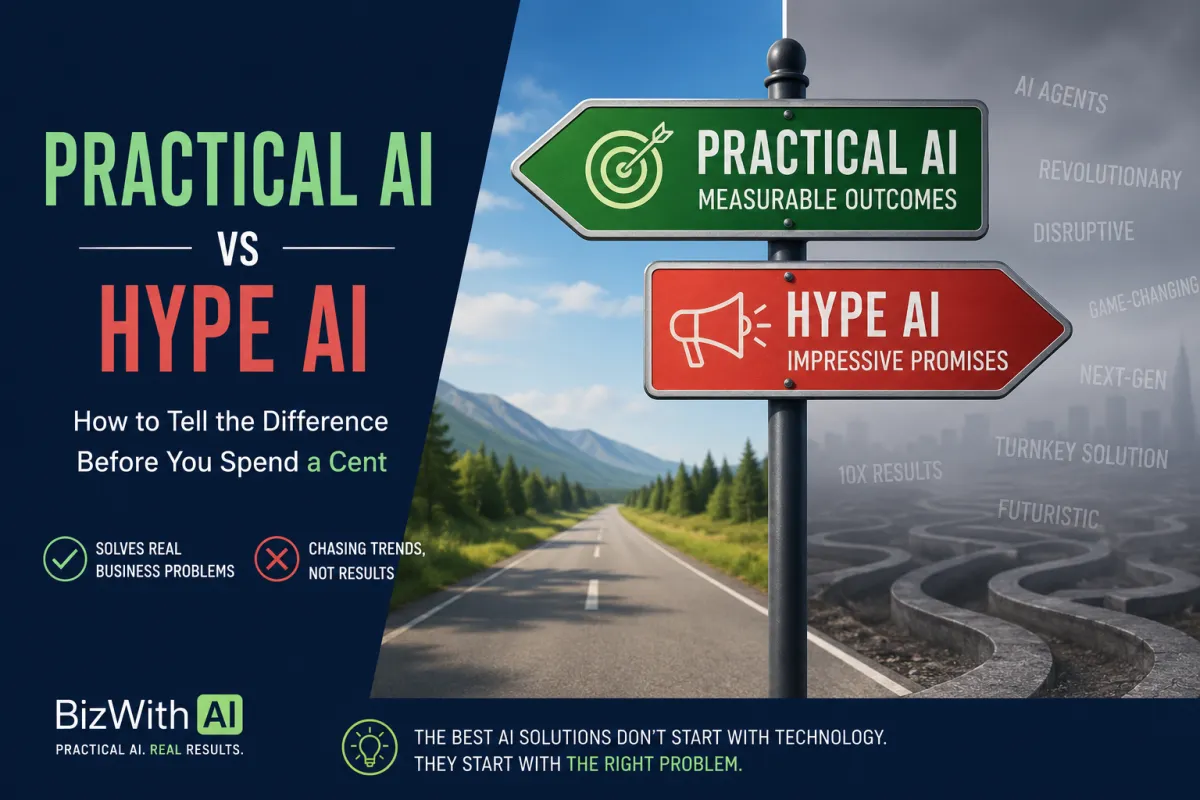
Practical AI vs Hype AI: How to Tell the Difference Before You Spend a Cent
AI is everywhere.
In our inboxes. In software demos. In LinkedIn posts. In boardroom conversations.
Every second product seems to have acquired an AI button, an AI assistant or, more recently, an AI agent.
And if you run a business, it can leave you with an uncomfortable feeling:
Am I missing something?
Maybe everyone else has figured this out already. Maybe your competitors are automating half their businesses while you're still answering emails, following up with prospects and trying to remember where Tuesday went.
The numbers certainly make it look that way.
According to Stanford University's 2026 AI Index, 88% of surveyed organizations are now using AI. Generative AI is being used in at least one business function by 70% of organizations.
So yes. Businesses are adopting AI.
But here's the part of the story we don't talk about nearly enough.
Using AI and getting business value from AI are not the same thing.
And that distinction matters enormously before you spend money on it.
We Don't Have an AI Adoption Problem
McKinsey's latest State of AI research found the same 88% adoption figure.
But nearly two-thirds of organizations surveyed still hadn't started scaling AI across their businesses.
Only 39% reported any measurable impact on EBIT from AI. And among those that did, most attributed less than 5% of EBIT to it.
That's a rather interesting gap.
88% are using AI.
39% can point to an impact on operating profit.
Something is happening between buying the technology and getting value from it.
I think that's where the conversation about AI needs to change.
Because perhaps the most useful question for a business owner in 2026 isn't:
"How can we use AI?"
It might be:
"What problem are we trying to solve?"
Those two questions can lead you down completely different roads.
This Is Where Hype AI Creeps In
Hype AI usually starts with the technology.
Someone sees a new tool.
Or watches an impressive demonstration.
Or hears that competitors are implementing AI agents.
And suddenly the conversation becomes:
"We should have one of those."
Then everyone starts looking around the business for somewhere to put it.
We've done this before.
CRM systems. Marketing automation. Social media. Chatbots. Apps. Digital transformation.
Technology arrives. We get excited about what it can do. And occasionally we buy the solution before we've properly defined the problem.
AI simply makes it easier because the demonstrations can be spectacular.
The irony is that Gartner is already warning about exactly this.
Gartner predicts that more than 40% of agentic AI projects will be cancelled by the end of 2027, citing escalating costs, unclear business value and inadequate risk controls.
Their researchers also warned that many current projects are being driven by hype rather than appropriate business applications.
That doesn't mean AI agents don't work.
Quite the opposite.
It means buying AI because AI is impressive isn't a business case.
Practical AI Starts Somewhere Else
Let's imagine you run a professional services business.
You receive 40 enquiries in a month.
Someone fills in a form on your website.
Another person sends an email.
Someone messages you after seeing something on social media.
A previous client says they might need your help again.
Your team intends to follow up with all of them.
But people get busy.
Three enquiries aren't followed up.
Two prospects receive proposals but nobody checks back with them.
Another person wants to book a meeting, but the email exchange stretches over three days.
That's not an AI problem.
That's a business problem.
Now we can ask whether AI or automation could help solve it.
Could enquiries automatically enter one system?
Could the right person be notified?
Could routine follow-up happen automatically?
Could meetings be booked without six emails going backwards and forwards?
Could a conversation be summarized before someone on your team takes over?
Could the owner see which opportunities have stalled?
Now we're having a very different AI conversation.
We aren't asking:
"What can AI do?"
We're asking:
"Where is work unnecessarily consuming time, money or opportunity?"
That's Practical AI.
The Best AI Might Be Quite Boring
There's another interesting finding in Stanford's 2026 AI Index.
Some of the clearest productivity improvements aren't happening in futuristic autonomous companies.
They're happening in fairly ordinary work.
Stanford's review of the research found productivity gains of around 14% to 15% in customer support, 26% in software development and 50% in marketing output in the studies it examined.
Importantly, the report says the strongest gains tend to occur in structured, measurable work where outputs are relatively easy to monitor.
That last sentence matters.
Because it suggests something rather less glamorous than the AI headlines.
Some of the best opportunities may be hiding inside the repetitive work we're already doing.
Following up.
Summarizing.
Categorizing.
Researching.
Updating systems.
Preparing information.
Routing enquiries.
Drafting first versions.
Finding information buried in documents.
Scheduling.
Reporting.
None of these will make particularly exciting keynote presentations.
But if they give someone five hours back every week, reduce missed opportunities or allow a business to serve more customers without adding another employee, the business case starts becoming much easier to understand.
Time Is Part of the ROI Calculation
This is something I believe businesses underestimate.
We tend to measure technology by what it costs.
$100 a month.
$500 a month.
$5,000 implementation.
Those numbers are visible, so we notice them.
Founder time often isn't.
Microsoft's 2025 Work Trend Index surveyed 31,000 people across 31 countries and found an extraordinary contradiction.
53% of leaders said productivity needed to increase.
At the same time:
80% of the global workforce said they lacked the time or energy to do their work.
That's the conversation about AI I'm far more interested in.
Not:
"How many AI tools does your business use?"
But:
"What work are humans still doing that isn't the best use of human time?"
Because those aren't the same question.
Practical AI vs Hype AI
Here's the simplest distinction I can make.
Hype AI starts with the technology.
We need an AI agent.
Practical AI starts with the problem.
We're losing enquiries because follow-up is inconsistent.
Hype AI asks:
What else can this tool do?
Practical AI asks:
Did this make the business better?
Hype AI measures activity.
We generated 500 pieces of content.
Practical AI measures outcomes.
Content production now takes four hours instead of twelve, without reducing quality.
Hype AI adds another piece of technology.
Practical AI removes friction.
And perhaps most importantly:
Hype AI needs AI to justify itself.
Practical AI doesn't care whether the solution is AI, automation, better software or simply a better process.
Sometimes the right answer genuinely isn't AI.
That's worth saying in an AI business.
The Practical AI Checklist
Before you buy the next AI tool, build an agent or automate another part of your business, try running the idea through these questions.
1. What problem are we actually solving?
Can you describe it without mentioning AI?
If you can't, there may not be a business case yet.
2. What is this problem costing us today?
Think beyond money.
Time.
Lost opportunities.
Slow response.
Errors.
Duplicated work.
Poor customer experience.
Founder dependency.
Those are costs too.
3. How often does the problem happen?
Automating something that happens twice a year probably isn't where I'd start.
Something your team repeats twenty times every day deserves considerably more attention.
4. Is the work structured enough to improve?
This is where the research becomes useful.
AI tends to perform particularly well where the work has a recognizable pattern and the output can be checked.
Look for repetition before complexity.
5. What happens after the AI does its part?
This one gets missed surprisingly often.
Generating an answer isn't necessarily completing a job.
Where does the information go?
Who receives it?
What happens next?
Does someone still have to copy it into another system?
A clever AI sitting outside the workflow can simply create another task.
6. Can we measure the before and after?
Before implementing anything, capture the baseline.
If follow-up currently takes ten hours a week, measure it.
If leads wait six hours for a response, measure it.
If preparing a report takes three hours, measure it.
Otherwise six months from now you'll know you're using AI, but you may have no idea whether it helped.
7. Does this free humans to do something more valuable?
This might be the most important question.
The objective shouldn't simply be removing humans.
It should be removing work that doesn't particularly need a human.
Because a lawyer's judgment matters.
A consultant's thinking matters.
A coach's conversation matters.
A business owner's relationships matter.
Copying information between systems probably doesn't.
8. Would we still buy this if nobody called it AI?
That's my favorite test.
Remove the label.
Remove the impressive demonstration.
Remove the fear of being left behind.
Would you still spend the money because the business outcome makes sense?
If the answer is yes, you're probably getting closer to Practical AI.
AI Doesn't Need More Hype
AI is extraordinary technology.
Its capabilities are improving incredibly quickly. Stanford reports that organizational adoption has reached 88%, while private AI investment continues to surge.
So this isn't an argument for ignoring AI.
It's almost the opposite.
AI is becoming too important to treat like a trend.
We should expect more from it.
Not another subscription.
Not another dashboard.
Not another impressive demo.
Something changed.
A task disappeared.
A customer got an answer faster.
A lead didn't get forgotten.
A founder got Friday afternoon back.
A team stopped copying information between systems.
A business increased capacity without immediately increasing headcount.
That's when AI stops being something we're talking about.
And starts becoming something that's working.
Perhaps that's the easiest way to tell Practical AI from Hype AI.
Don't ask whether the AI is impressive.
Ask what is different in the business because it's there.
If we can't answer that yet, perhaps we shouldn't spend the cent.