
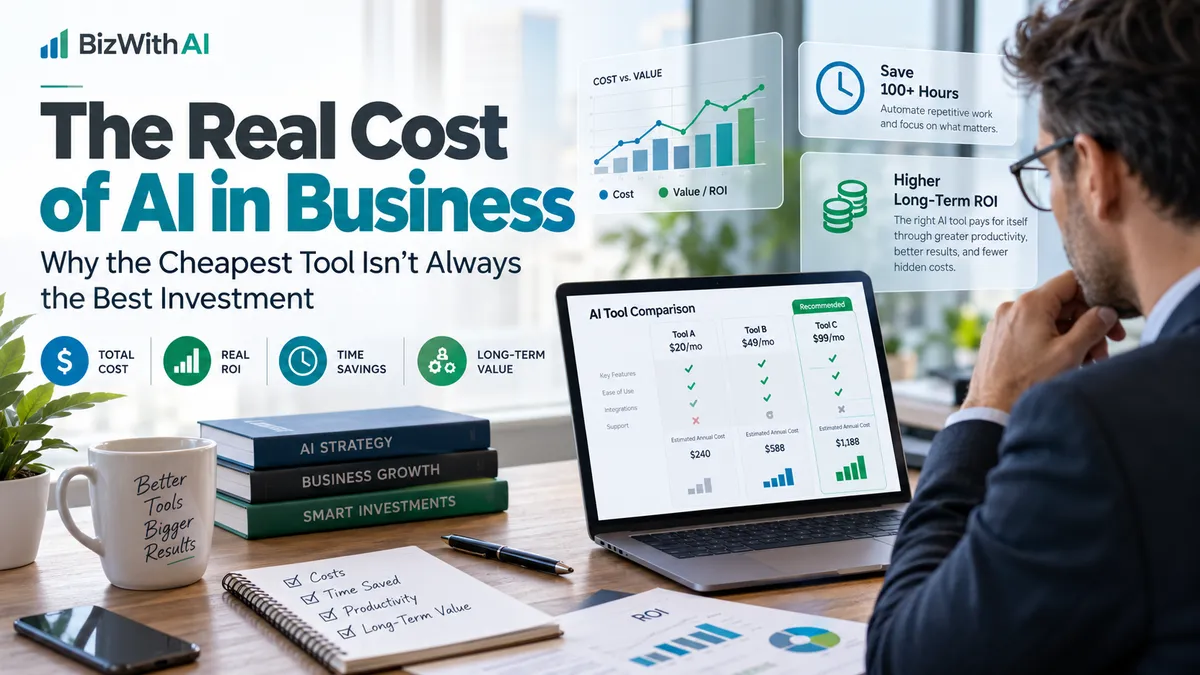
The Real Cost of AI in Business | BizWithAI Copy
The Real Cost of AI in Business: Why the Cheapest Tool Isn't Always the Best Investment
Before you pay for another AI tool, ask yourself one simple question: What is it actually going to improve in my business?
Artificial intelligence has made some extraordinary things possible for businesses of all sizes.
Tasks that once took hours can sometimes be completed in minutes. Small teams can accomplish work that previously required additional resources. Business owners have access to capabilities that would have been difficult or expensive to obtain just a few years ago.
And yet, there is something I find interesting.
We spend an enormous amount of time discussing what AI tools can do and surprisingly little time examining what they actually cost us.
I'm not just talking about their subscription fees.
I'm talking about the time spent learning them, connecting them to existing systems, checking their work and sometimes fixing what they get wrong.
Because the cheapest AI tool isn't necessarily the one that costs the least.
It's the one that delivers the greatest useful value for the total investment required.
The $20 Subscription That Costs Far More Than $20
Imagine a business owner discovers an AI tool that promises to save hours every week.
The subscription is only $20 per month.
That sounds reasonable.
But then the business owner spends four hours learning how to use it, another three hours experimenting with prompts and workflows, and an hour every week checking and correcting the results.
Suddenly, that inexpensive subscription requires considerably more investment than the advertised price suggests.
None of that means the tool is a bad investment.
It simply means we need to evaluate its actual cost.
A tool that requires ten hours to implement but saves five hours every week could be an excellent investment.
A tool that costs almost nothing but produces unreliable results may never deliver meaningful value.
Price tells you what you're paying. Value tells you what you're getting.
The Five Costs Most Businesses Overlook
When evaluating an AI investment, I encourage business owners to consider five areas.
1. The Subscription or Usage Cost
This is the obvious one.
Some AI tools charge a fixed monthly subscription. Others charge according to usage, the number of users, the volume of information processed or the capabilities being used.
AI models accessed through APIs can have separate charges for input and output tokens, cached information and additional services.
That means two tools offering similar capabilities can generate very different bills depending on how they are used.
The important question isn't simply, "How much does it cost per month?"
It's, "How much will it cost for the amount of work my business actually needs?"
2. The Cost of Implementation
A tool doesn't automatically become useful because you've subscribed to it.
You may need to configure it, connect it to existing systems, establish processes, train employees or change the way work gets done.
Consider a business that wants AI to help respond to customer enquiries.
The AI might be capable of preparing excellent responses.
But where do those enquiries arrive?
Who reviews them?
How does the business know which enquiries require immediate attention?
Where is the information recorded?
What happens when the AI cannot answer correctly?
Those questions are part of implementation.
Without answering them, a promising tool can easily become another disconnected application.
3. The Cost of Human Involvement
AI can reduce the time required to complete certain tasks, but it doesn't automatically eliminate human responsibility.
Someone still needs to check important information, make decisions and manage exceptions.
This is particularly important when working with client information, financial figures, legal matters or business-critical communications.
A business owner might save an hour generating a document but spend another hour checking and correcting it.
The net saving is then very different from the headline claim.
A good AI system should reduce unnecessary work without introducing unacceptable risks.
4. The Cost of Mistakes
This is probably one of the most underestimated costs.
AI can produce information that sounds convincing but is incorrect.
A wrong figure in a proposal, an inaccurate statement in a client email or incorrect information passed between systems can create more work than it saves.
Some mistakes are inexpensive to correct.
Others can affect client relationships, compliance, reputation or revenue.
The answer isn't to avoid AI.
It's to build sensible checks into the process and use human approval where the consequences justify it.
5. The Cost of Doing Nothing
There is another side to the calculation.
Not adopting a useful technology also has a cost.
If your team spends hours manually transferring information, repeatedly following up with prospects or preparing routine reports, that work consumes capacity.
Sometimes the greatest opportunity isn't reducing expenditure.
It's making better use of the time and resources you already have.
But that opportunity must be measured, not simply assumed.
A Practical Example: Is the AI Investment Worth It?
Let's take a simple example.
Imagine a professional services business spends ten hours every week on a recurring administrative task.
The business introduces an AI-supported process.
After testing, the work now requires four hours per week, including human checking.
The business has reclaimed six hours of capacity every week.
Now let's examine the numbers.
Measurement | Illustrative result |
|---|---|
Time previously required | 10 hours per week |
Time after introducing AI | 4 hours per week |
Capacity reclaimed | 6 hours per week |
Monthly capacity reclaimed | 26 hours |
Estimated internal hourly cost | $30 |
Monthly capacity value | $780 |
AI subscription and usage | $80 per month |
Ongoing maintenance and review | $100 per month |
Net monthly capacity value before implementation | $600 |
Illustrative assumptions only. Monthly hours are calculated using 52 weeks divided by 12. All values are in USD.
On paper, this looks like a promising investment.
But there are two important considerations.
First, reclaimed time is not automatically money saved.
If you're paying an employee the same salary, the business hasn't necessarily reduced its cash expenditure.
It has released 26 hours of capacity that could potentially be used for more productive work.
The financial return depends on what happens with those hours.
Second, implementation has a cost.
Suppose the business spends $1,200 implementing the process.
If the full $600 monthly benefit becomes economically real, the simple payback period would be approximately two months.
But if the additional capacity isn't used productively, or the process requires more supervision than expected, the return will be lower.
That's why measuring the actual results matters.
How to Calculate the Real Return on Your AI Investment
You don't need a complicated financial model to get started.
Begin with one process.
Step 1: Measure the work before introducing AI.
Record how often the task happens, how long it takes, who performs it and what problems occur.
Without a baseline, it's difficult to know whether anything has improved.
Step 2: Calculate the full cost of the proposed solution.
Include subscriptions, usage charges, implementation, integrations, training, ongoing maintenance and human review.
Step 3: Test the process on real, representative work.
Don't rely exclusively on a demonstration or sales promise.
A tool may perform beautifully with a simple example and struggle with the messy information your business handles every day.
Step 4: Measure the difference.
Did the process become faster? Were there fewer errors? Did your team spend less time correcting information? Did customers receive better service?
Step 5: Decide what the improvement is worth.
Perhaps the result is lower expenditure.
Perhaps it is greater capacity, faster turnaround, better customer experiences or additional revenue opportunities.
Each is valuable, but they aren't interchangeable.
A simple starting formula is:
Monthly Net Benefit = Financial Value Realised − Ongoing AI Costs
And when the benefits can be reliably expressed in financial terms:
ROI (%) = (Net Benefit ÷ Total Investment) × 100
Be careful not to double-count benefits. For example, don't count the same saved employee hours as both labour savings and additional revenue unless you have evidence that both benefits were actually realised.
Before You Buy Another AI Tool, Ask These Seven Questions
What specific business problem am I trying to solve?
How much is that problem currently costing me?
Will AI solve the problem or simply make part of the process faster?
How much implementation and human involvement will be required?
What happens if the AI makes a mistake?
How will I measure whether it is working?
What would make me stop, change or expand the investment?
Those seven questions can prevent an enormous amount of wasted time, money and frustration.
They also change the conversation.
Instead of asking which AI tool is the cheapest, you begin asking which business outcome is worth investing in.
Sometimes the Best AI Investment Isn't Another AI Tool
One of the most useful things I've learned from years of working with businesses is that technology doesn't automatically fix a broken process.
If enquiries are being lost because nobody follows up, introducing another AI application may not solve the underlying problem.
If employees spend hours looking for information because it is scattered across different systems, generating more information won't necessarily improve the situation.
And if nobody has defined how a business process should work, automating it can simply make the confusion happen faster.
Sometimes the smartest place to start is with a process review.
Understand what is happening.
Identify where time, money or opportunities are being lost.
Then determine whether AI, automation, better systems or a simple change in procedure will deliver the most value.
Technology should serve the business.
The business shouldn't have to reorganise itself around every new technology.
The Question That Really Matters
AI is developing quickly, and the growing range of tools and capabilities is genuinely exciting.
But business owners don't need to become experts in every new model or platform.
They need to understand enough to make good decisions.
You don't need the most advanced AI solution.
You don't necessarily need the cheapest one either.
You need the right solution for the work that matters.
And you need a way to know whether it's delivering the results you expected.
Because, ultimately, the real value of AI isn't what the technology can do. It's what it helps your business achieve.
A Useful Place to Start
If you've already introduced AI into your business, here's something worth doing this week.
Choose one process where you're using it.
Measure the time, cost and effort involved before and after.
Then ask whether the improvement is producing genuine business value.
And if you're not sure where to begin, our FounderROI assessment is designed to help you start thinking more clearly about the numbers behind your business decisions.
For more practical insights about AI, business systems, costs and automation, subscribe to our weekly publication:
Generosity as a Service | AI Insider
No hype. Just practical information to help you put AI to work in your business.
Tilly Davies
BizWithAI
Taking the hype out of AI and putting it to work in business.