
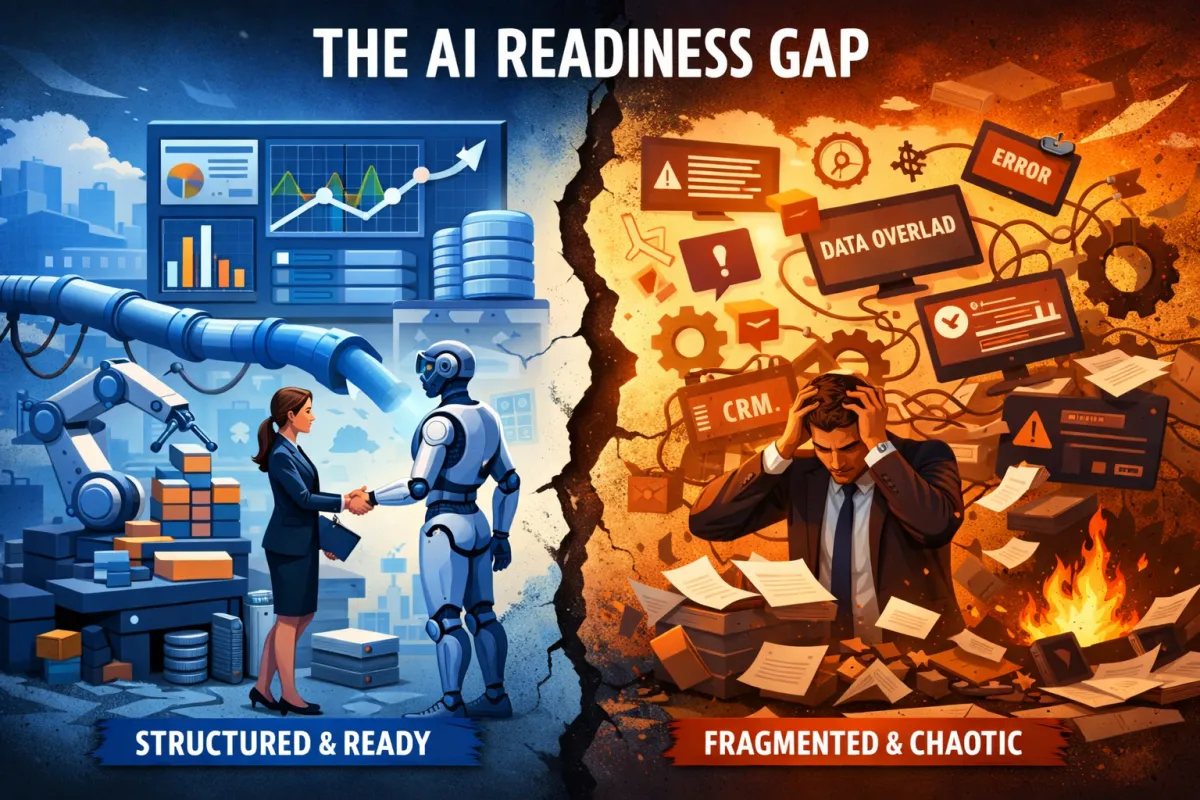
The AI Readiness Gap: Why Most Businesses Automate Chaos
For the last two years, businesses have been told the same story about AI.
Adopt early.
Move fast.
Use more tools.
Build agents.
Automate everything.
And yet, something strange is happening beneath the surface.
Many businesses that have “adopted AI” feel no lighter.
No calmer.
No more in control.
In fact, some feel worse.
More dashboards to check.
More tools to manage.
More automations to babysit.
More decisions to make.
More complexity layered onto an already fragile operation.
At the same time, a smaller group of businesses are quietly pulling ahead.
They respond faster without panic.
Follow-up happens without reminders.
Pipelines feel clearer.
Teams feel supported instead of stretched.
Decision-making becomes easier, not harder.
Both groups are using AI.
So what’s the difference?
It isn’t intelligence.
It isn’t budget.
It isn’t ambition.
It’s readiness.
AI Does Not Create Leverage. It Multiplies Structure.
This is the first truth most AI conversations avoid.
AI does not fix broken systems.
It does not clarify unclear processes.
It does not replace operational discipline.
It does not remove the need for structure.
AI amplifies whatever already exists.
If your systems are fragmented, AI multiplies the fragmentation.
If your follow-up is inconsistent, AI makes the gaps more visible.
If your CRM is just a database, AI exposes how much your business relies on memory instead of process.
This is why two businesses can use the same tools and get completely different outcomes.
One compounds advantage.
The other compounds friction.
The AI Readiness Gap No One Is Talking About
Most businesses assume readiness begins when they choose a tool.
That assumption is costly.
In reality, AI readiness exists across several invisible layers that most teams never audit before implementing automation.
These layers include:
• how leads enter the business
• how conversations are tracked and followed up
• whether data lives in one place or many
• whether workflows are documented or improvised
• whether the CRM drives action or stores history
• whether decisions are system-led or memory-led
When these layers are weak, AI doesn’t help.
It accelerates confusion.
This is the AI Readiness Gap.
And it’s the reason so many AI projects fail quietly.
No dramatic crash.
Just disappointment, complexity, and fatigue.
Why Early AI Adopters Often Get Worse Results
This is the most counterintuitive part of the AI story.
Early adopters often assume speed equals advantage.
They implement tools quickly, stack automations, and push ahead without pausing to assess foundations.
The result?
Automation built on unclear processes.
AI agents operating on poor data.
Follow-up sequences that feel robotic or mistimed.
Teams overwhelmed by systems they don’t trust.
Founders still carrying everything mentally.
The business looks advanced on the outside.
But internally, it’s brittle.
Meanwhile, businesses that slow down to assess readiness first often leapfrog early adopters with fewer tools and better outcomes.
When a CRM Becomes a Liability
One of the clearest readiness signals sits at the center of most businesses: the CRM.
In many organisations, the CRM is:
• a storage system
• a reporting tool
• a digital filing cabinet
But not an operational brain.
When a CRM does not drive next actions, surface risks, or support follow-up automatically, it becomes a silent liability.
AI layered onto a passive CRM doesn’t create intelligence.
It highlights how little intelligence was there to begin with.
Modern businesses are shifting toward CRMs that think, not just record.
This shift alone explains much of the growing gap between businesses that feel calmer and those that feel overwhelmed.
The Hidden Cost of Memory-Based Businesses
If your business still relies on people remembering to:
• follow up
• chase responses
• move deals forward
• update records
• trigger next steps
AI will not fix that.
In fact, AI makes the cost of memory-based operations painfully obvious.
The businesses winning with AI have already removed memory as a bottleneck.
Their systems hold continuity.
Their workflows anticipate next steps.
Their teams are supported by structure, not burdened by it.
This is not about working harder.
It’s about designing smarter.
Readiness Before Automation Is the Real Advantage
The businesses pulling ahead are not asking:
“What AI tools should we use?”
They are asking:
“Is our business safe to automate?”
That question changes everything.
It leads to audits instead of guesses.
Diagnostics instead of demos.
Infrastructure decisions instead of tool experiments.
Readiness-first businesses automate with confidence.
Everyone else automates with hope.
Why This Conversation Matters Now
AI is no longer optional.
But reckless automation is expensive.
As AI becomes embedded into everyday operations, the cost of getting this wrong increases.
Lost leads.
Damaged trust.
Burnt-out teams.
Fractured customer experiences.
Founders trapped in systems they don’t understand.
The next era of business will not be won by those who adopt fastest.
It will be won by those who prepare properly.
A Better Way Forward
Before automating anything, businesses need clarity.
Clarity on:
• where AI will help immediately
• where AI will make things worse
• what must be fixed first
• what not to automate yet
• whether their current systems can support intelligence
This is why AI readiness assessments are becoming a strategic necessity rather than a nice-to-have.
Because once AI touches your business, it amplifies everything.
The question is not whether AI will change how you operate.
It already has.
The real question is whether it’s multiplying advantage or magnifying chaos.