
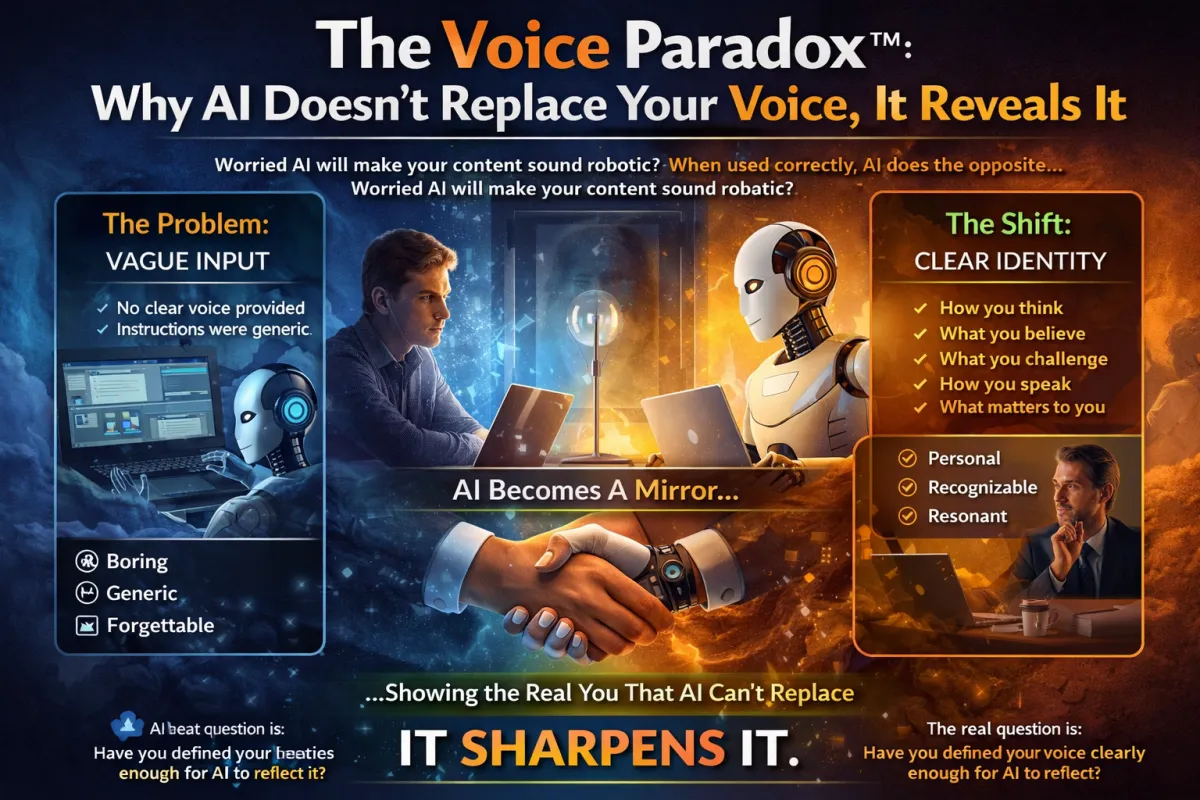
The Voice Paradox™: Why AI Doesn’t Replace Your Voice, It Reveals It
The Voice Paradox™: How AI Makes You Sound More Like Yourself When Used Correctly
There’s a quiet fear sitting underneath almost every conversation about AI.
You can hear it in the hesitation.
You can feel it in the resistance.
Sometimes it’s said out loud, sometimes it isn’t.
“What if this makes everything sound the same?”
And it’s a fair question.
Because if you’ve spent any time online recently, you’ve seen it.
Content that is clean, structured, technically correct… and completely forgettable.
Words that look right, but don’t stay with you.
Messages that sound like they could belong to anyone.
And so the instinct is to pull back.
To hold onto your voice more tightly.
To keep things manual, controlled, human.
Because somewhere inside, you know your voice matters.
Not just what you say.
But how you say it.
And here’s where the paradox begins.
Because the problem is not that AI removes your voice.
It’s that most people have never actually defined it.
When there is no clear voice to begin with, AI doesn’t distort it.
It reflects the absence of it.
That’s why so much AI-generated content feels the same.
Not because AI is making it generic.
But because the input it receives is generic.
Vague instructions.
Unclear positioning.
Undefined tone.
And when you feed something that lacks identity into a system designed to produce output…
You don’t get clarity.
You get amplification of the blur.
So what people are reacting to isn’t AI itself.
They’re reacting to what happens when AI is used without direction.
Now let’s shift this.
Because something very different happens when identity is clear.
When you know:
how you think
what you believe
how you see your market
what you agree with
what you challenge
When those things are defined, even if only for yourself…
AI stops sounding generic.
And starts sounding familiar.
Not because it suddenly became more intelligent.
But because it finally has something real to work with.
Think about your own voice for a moment.
Not the polished version.
Not the “professional” version.
The real one.
The way you explain things when you’re not overthinking.
The way you challenge ideas when something doesn’t sit right.
The way you naturally emphasise what matters and dismiss what doesn’t.
That voice is already there.
It’s just rarely captured.
And that’s what most people misunderstand about AI.
They think it’s there to create something new.
When in reality…
Its greatest strength is helping you extract what’s already there.
When used correctly, AI becomes less of a generator…
And more of a mirror.
It reflects your patterns.
Your preferences.
Your way of thinking.
But only if you give it something specific enough to reflect.
This is where the shift happens.
You stop asking:
“What should I write?”
And start asking:
“What do I actually think about this?”
Because once that becomes clear…
Everything changes.
Your content stops sounding like something you’re trying to produce.
And starts sounding like something you would actually say.
There’s a certain ease that comes with that.
A reduction in effort.
Not because you’re doing less.
But because you’re no longer forcing alignment.
And this is where AI becomes powerful in a way most people don’t expect.
Not because it replaces your voice.
But because it removes the friction between your thinking and your output.
You’re no longer staring at a blank page.
You’re no longer trying to “sound right.”
You’re simply… refining.
Directing.
Shaping.
And the result is something that feels closer to you than what you would have written alone.
Not further away.
That’s the paradox.
The clearer your identity…
The more authentic AI becomes.
The less clear your identity…
The more artificial it feels.
So the real question is not:
“Will AI make me sound generic?”
It’s:
“Have I defined my voice clearly enough for AI to reflect it?”
Because if you have…
AI doesn’t dilute you.
It sharpens you.
It gives you consistency without losing character.
Speed without losing depth.
Structure without losing personality.
And in a world where most content is either:
fast but empty
or thoughtful but inconsistent
That combination becomes incredibly powerful.
You don’t just sound different.
You sound… recognisable.
And recognition is what builds trust.
Not perfection.
Not polish.
Recognition.
Because when someone reads your content and feels:
“This sounds like them.”
That’s when your voice is no longer just something you use.
It becomes something people associate with you.
And that’s where real positioning begins.
So maybe the fear around AI isn’t really about sounding the same.
Maybe it’s about being confronted with something else.
That your voice has never been fully defined.
And that’s not a weakness.
It’s an opportunity.
Because once you define it…
You don’t just protect it.
You scale it.