
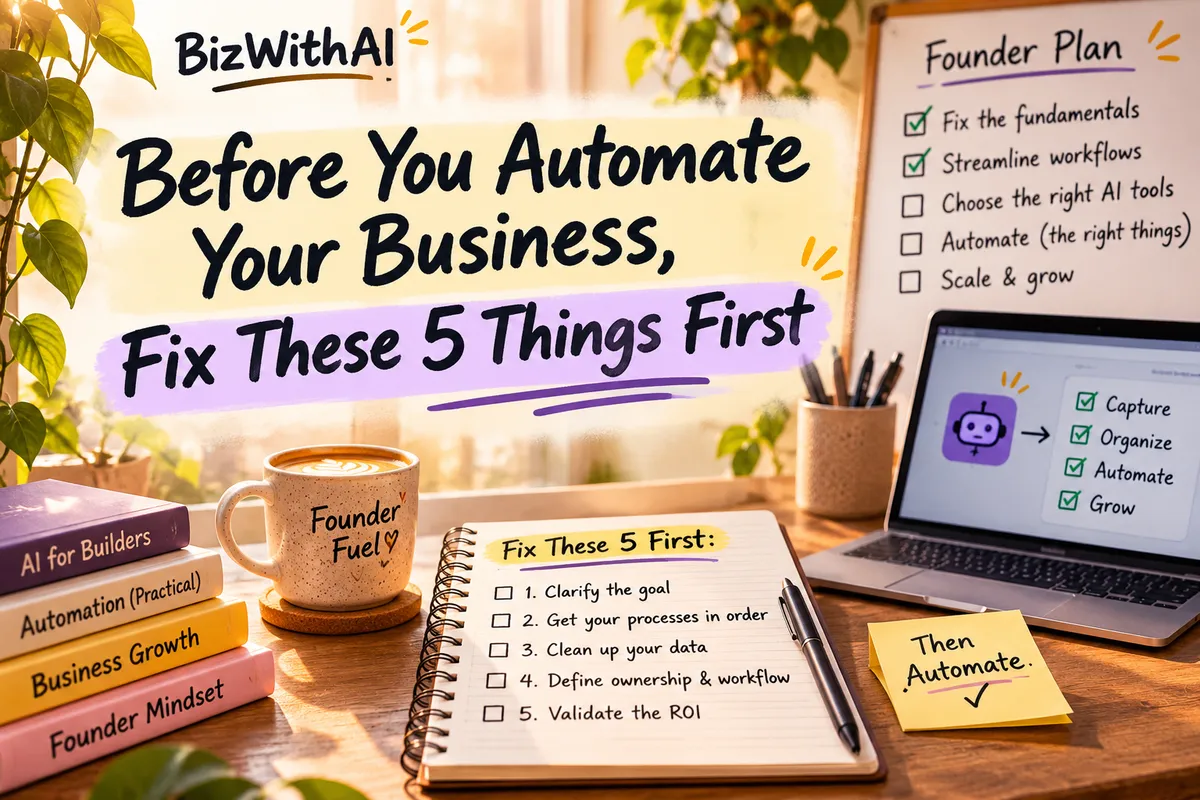
Before You Automate Your Business, Fix These 5 Things First
Before You Automate Your Business, Fix These 5 Things First
I've spent a lot of time working with AI and automation recently, and something keeps coming up.
It's not the technology that gives me the biggest headache.
It's trying to make technology follow a business process that hasn't been properly thought through.
You would think that after all my years working in business and technology, I would have learned this lesson by now.
But even I get caught up in what the latest technology can do.
And that's exactly where things can go wrong.
A new AI tool promises to save hours. An automation demonstration makes everything look so easy. Somebody shows you how to build an AI agent that can manage a dozen tasks.
It's tempting to jump straight in.
But before you automate your business, there's a question worth asking.
Do you actually know how the work should be done?
Because if you don't, there's a good chance your new automation will simply make the confusion happen faster.
Why automating a broken process creates more work
Think about something as simple as an enquiry arriving through your website.
A potential customer completes a form.
What should happen next?
Somebody should receive the enquiry. The customer should receive an acknowledgement. The enquiry should be assigned to the right person. And somebody should follow up.
Simple enough.
Now imagine your business receives enquiries from your website, Facebook, WhatsApp, email and phone calls.
Each one arrives somewhere different.
Sometimes somebody responds immediately. Sometimes the message sits in an inbox. Sometimes two people contact the same prospect.
And sometimes nobody follows up at all.
You could add AI to respond to those enquiries.
But unless you've decided where the enquiries should go, who is responsible and what should happen next, you're adding technology to a problem that still exists.
The first job is to understand the process.
Then you can decide what technology should do.
1. Fix the way information enters your business
The first thing I would examine is where your business information comes from.
For a service business, this might include website enquiries, calls, booking forms, social media messages and emails.
Do they all arrive in one place?
Can somebody see which enquiries are new, which have been answered and which need attention?
Or do you have to search through different applications to find out what's happening?
You don't necessarily need a new system immediately.
Start by writing down every place where customers contact your business.
Then ask:
Where does this enquiry go?
Who sees it?
Who is responsible for responding?
How do we know whether it has been handled?
If you cannot answer those questions, that's where I would start.
AI can help you classify enquiries, draft replies and identify urgent requests.
But it needs reliable information to work with.
The first improvement is visibility. Knowing what's coming into the business and what is happening to it.
2. Fix your follow-up process
This is probably one of the most overlooked areas in smaller businesses.
Somebody enquires about your services.
You reply.
They don't answer immediately.
Then what?
Does somebody follow up the next day? Three days later? A week later?
Or does the conversation simply disappear?
I've seen businesses spend time and money trying to attract more customers while paying very little attention to the people who have already shown interest.
That makes no sense to me.
Before automating follow-ups, decide what a good follow-up process should look like.
A new enquiry may need a quick acknowledgement.
Someone who has received a proposal may need time to consider it.
A customer who has already purchased should not continue receiving sales reminders.
And somebody who tells you they're not interested should have that decision respected.
These are different situations. They need different responses.
Once those rules are clear, automation can help your team respond consistently.
It can remind somebody to call, send an appropriate message or update the customer record.
But you still need to decide when a person should take over.
Good follow-up isn't about sending more messages. It's about making sure the right conversation happens at the right time.
3. Fix the decisions people make every day
Here's something I discovered while reviewing our own appointment-booking workflow.
At first, the process looked straightforward.
Someone books a call. They receive a confirmation. After the call, they receive a follow-up.
But when I started questioning the process with ChatGPT, the exceptions became obvious.
What if the booking is from an existing customer?
What if it's a business partner rather than a prospect?
What happens when somebody cancels?
What happens if they reschedule?
What if they don't attend?
And what if they attended but are not ready to buy?
The original process didn't adequately distinguish every situation.
That was the important discovery.
Not a clever piece of technology.
A better understanding of the decisions the system would need to make.
We then worked through the process one decision at a time.
Who should enter the workflow?
What information must be checked?
What could happen next?
What should the system do in each situation?
When should a person intervene?
This is something I strongly recommend doing before building any automation.
Take one everyday process and question it.
Ask somebody on your team to explain what they do.
Then ask what happens when things don't go according to plan.
You'll often discover that the real work happens in the exceptions.
And those exceptions are exactly what an automation needs to handle properly.
4. Fix the information your business depends on
An automation is only as useful as the information it receives.
Imagine asking AI to follow up with customers when your customer records contain outdated email addresses, duplicate contacts and missing appointment details.
Or asking it to prepare reports when the information is spread across several applications.
It might produce something that looks impressive.
But can you trust it?
Before connecting AI to your business information, spend some time examining the information itself.
Are customer records accurate?
Are the important fields being completed?
Can you tell the difference between a prospect and an existing customer?
Do you know which opportunities are active?
And does your team update records when something changes?
You don't need perfect information to get started.
But you do need enough reliable information to make the automation useful.
A simple way to test this is to take ten recent customer records and examine them.
Can you see where each enquiry came from?
Who last contacted the customer?
What happened?
What should happen next?
If those answers are missing, fix the recordkeeping process first.
Then consider where AI can reduce the manual work.
5. Fix the way you measure success
This is where many automation projects become difficult to judge.
Someone builds a workflow.
It runs.
Messages go out.
Tasks are completed.
Everybody is pleased because the automation works.
But has the business improved?
That's a different question.
If you automated appointment reminders, did fewer people miss their appointments?
If you automated enquiry follow-ups, did response times improve?
If AI started handling repetitive administration, did your team actually gain useful time?
And was that time used for something more valuable?
Before automating a process, choose one or two things you can measure.
For example:
Process | What to measure |
|---|---|
New enquiries | Time to first response |
Sales follow-up | Percentage of enquiries followed up |
Appointments | Attendance and no-show rate |
Administration | Time spent completing a task |
Customer records | Missing or incorrect information |
Measure the current situation first.
Then measure it again after introducing the automation.
Otherwise, you're judging success by whether the technology runs, not whether it helps the business.
And there's one more thing.
Time saved does not automatically mean money saved.
If AI reduces a task from an hour to fifteen minutes, you've gained forty-five minutes of capacity.
What that capacity is worth depends on what happens next.
That's the kind of return I believe business owners should be examining.
What should you actually automate first?
After looking at these five areas, you may discover several opportunities.
But I wouldn't automate everything at once.
Start with one process that is repeated frequently, follows clear rules and takes up time that could be better spent elsewhere.
It should also be relatively safe to test.
For example, sending an internal reminder when an enquiry hasn't been assigned may be a good starting point.
Allowing an AI system to make important commitments to customers without review is a very different matter.
A useful first automation usually has five qualities:
It solves a problem you can describe clearly.
The steps and decisions are understood.
The information it needs is available.
A person can intervene when necessary.
You can measure whether it made things better.
If those conditions are missing, there's probably more preparation to do.
And that's perfectly fine.
Preparation isn't wasted time. It's part of doing the work properly.
Where does RoboLead fit into this?
At BizWithAI, we use RoboLead to bring important parts of a business's online operations together.
It can manage enquiries, customer records, conversations, appointments and follow-ups in one connected system.
That matters because automation works better when information isn't scattered across disconnected applications.
For example, a new enquiry can enter the CRM, be assigned to somebody, trigger an acknowledgement and remain visible as it moves towards an appointment or sale.
AI can then support appropriate tasks inside the process.
But the system alone doesn't guarantee success.
You still need to decide what should happen, who is responsible and how you'll measure the outcome.
That's why our approach at BizWithAI begins with understanding the business before choosing what to automate.
We want AI to make the business easier to run, not give the owner another complicated system to manage.
The best place to start might surprise you
There's a great deal of excitement around AI agents, automated workflows and software that can carry out tasks on your behalf.
And much of that technology is genuinely useful.
I'm excited about it too.
But I keep coming back to a lesson I've learned throughout my career.
The technology is rarely the whole answer.
It's the people, the processes, the decisions and the way everything works together that make the difference.
Sometimes the biggest improvement isn't a sophisticated AI agent.
It's making sure every enquiry receives a reply.
Or making sure your team knows what to do when an appointment is cancelled.
Or discovering why a simple administrative task takes three times longer than it should.
Those are practical improvements.
And they are often where the real value begins.
Before asking what else AI can do for your business, ask what your business needs to do better.
You may discover that you already have much of the technology you need.
You simply need to put it to work properly.
Not sure where your business is losing time?
Our Process Waste Assessment helps you examine where repetitive work, unnecessary steps and inefficient processes may be slowing your business down.
It's a useful starting point before deciding what to automate.
Take the Process Waste Assessment
Taking AI out of the Hype. Putting AI to work in Your Business.